There is a temptation in adaptive reuse to make the transformation complete.
The factory becomes apartments. The convent becomes a hotel. The warehouse becomes a gallery. The vocabulary changes, the furniture arrives, and eventually the former life of the building survives mainly in the paragraph explaining its history.
At HOSHINOYA Nara Prison, that would have been difficult.
The architecture refuses to forget.
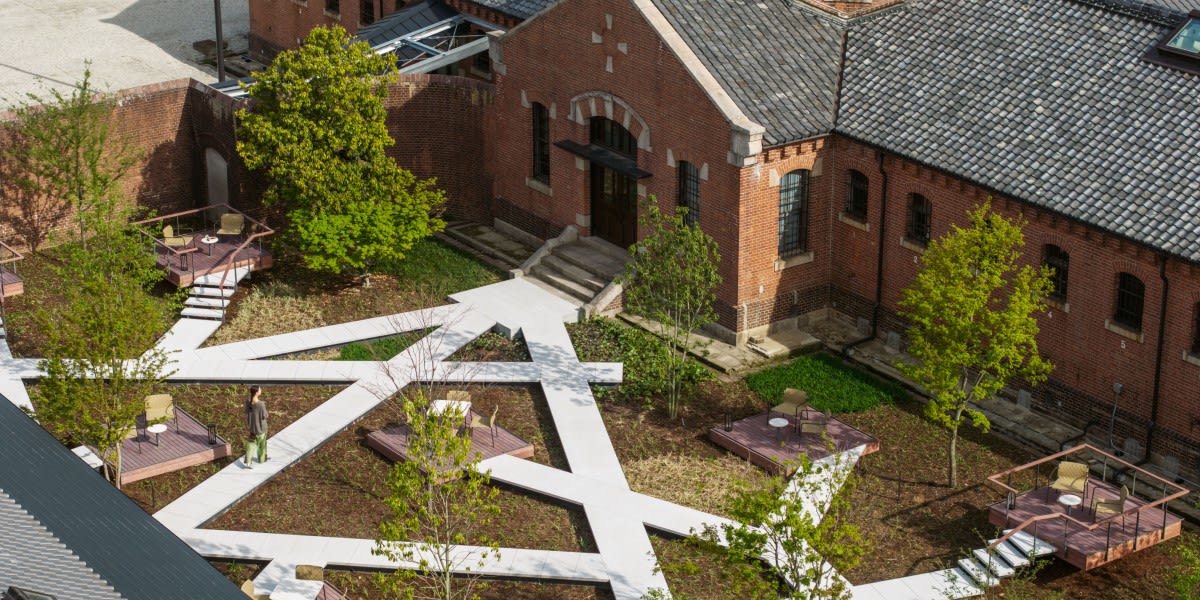
Completed in 1908, the former Nara Prison was part of an ambitious Meiji-era programme to modernise Japan's judicial infrastructure. Architect Keijiro Yamashita designed five cell wings radiating from a central guardhouse, using a prison-planning system intended to allow efficient observation from a single point.
Red brick gave the institution an almost civic grandeur.
More than a century later, that architecture remains remarkably intact. The prison was designated a National Important Cultural Property in 2017; after years of restoration and seismic work, the complex has now begun another life. A museum opened in April. In June, 48 suites opened within the same walls as HOSHINOYA Nara Prison.
The cell remains
Rather than constructing conventional hotel rooms behind the historic façade, the designers worked with the building's most fundamental unit: the cell.
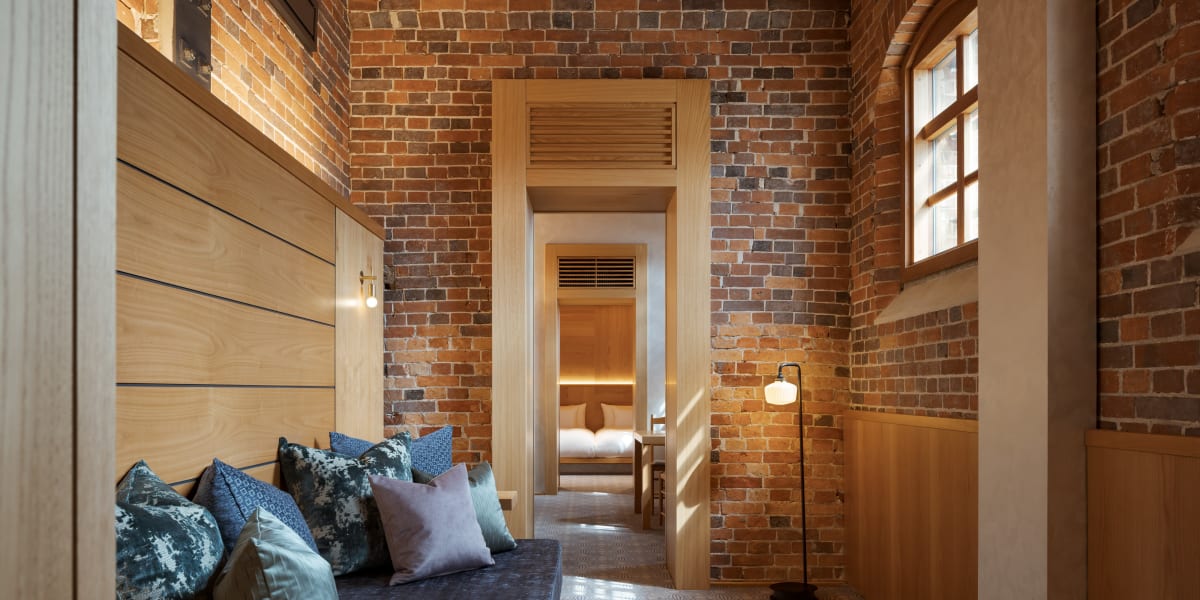
Multiple former cells have been combined to create each suite. In one configuration, ten solitary cells become a single guest room. Their divisions still establish a rhythm through the interior, allowing sleeping, living and dining spaces to occupy what were once separate spaces of confinement.
Old brick, previously concealed beneath plaster, has been exposed. Original ceiling mouldings remain. New structural steel sits visibly beside timber panelling and contemporary furniture.
The effect is not historical reconstruction.
Nor is it the increasingly familiar luxury strategy of retaining one distressed wall as evidence of authenticity.
The building's previous purpose remains legible.
That creates an uncomfortable but productive question: how much should a new use be allowed to overwrite an old one?
Preservation is not decoration
Hotels are particularly good at turning history into atmosphere.
A monastery supplies silence. A palazzo supplies grandeur. A farmhouse supplies rusticity. Once absorbed into hospitality, the past can become another material palette.
A prison resists that process.
Its walls were built for restriction. Its circulation was designed for surveillance. Its cells existed because someone's freedom had been removed.
Making those qualities aesthetically pleasing cannot neutralise them.
HOSHINOYA's strongest decision may therefore be the separation between hotel and museum.
The adjacent Nara Prison Museum occupies part of the former complex and remains accessible to day visitors. Its exhibitions address the architecture, prison life, discipline, rehabilitation and ideas of freedom rather than allowing the site's history to exist only as a backdrop for paying guests. Hotel guests can also enter the museum through a dedicated connection.
Hospitality and interpretation coexist.
Neither completely replaces the other.
A different measure of luxury
There is something else happening inside the suites.
Luxury is usually associated with freedom: more space, more choice, more privacy, fewer restrictions.
Here, the architecture begins with the physical evidence of the opposite.
That contradiction gives the rooms a quality a newly constructed luxury hotel could never manufacture.
The brick is not a finish selected from a sample board. The unusual proportions are not an architect's attempt to create character. The circulation does not twist because someone wanted a dramatic arrival sequence.
They exist because another institution needed them first.
The new design has to negotiate with those facts.
And perhaps that is where the project becomes relevant beyond Nara.
As hospitality increasingly searches for buildings with stories, adaptive reuse can easily become a hunt for aesthetic character: old beams, worn stone, beautiful decay.
But heritage is more demanding than texture.
To inherit a building is also to inherit the parts of its story that are inconvenient.
What deserves to remain?
The best adaptive reuse does not freeze architecture in time.
Buildings need new lives precisely because the world around them has changed. Preservation without viable use can leave important structures impeccably protected and completely empty.
The alternative is not erasure.
It is negotiation.
At Nara, a former cell can become part of a bedroom while still reading as a cell. A guardhouse can organise the movement of hotel guests while still revealing the logic of surveillance that created it. Brick walls can become beautiful in a new context without requiring us to pretend they were built for beauty alone.
That tension may be more valuable than seamlessness.
“The most interesting old buildings do not need their previous lives edited out. They need a new use capable of living beside them.”
HOSHINOYA Nara Prison is an extreme example.
Most adaptive-reuse projects will not carry such difficult institutional histories. But the question it raises applies almost everywhere.
When we transform a place, what should the new design change?
And what should it have the confidence to leave alone?